Microsoft 365 pricing changes in 2026




Microsoft's 2026 pricing changes arrive in two waves: currency adjustments on February 1, suite restructuring on July 1. On the surface, these feel like separate events. They're not. Together, they create a critical six-month planning window, and the organizations that benefit are the ones that understand how they connect.
For organizations in affected European markets, February 1 creates immediate opportunity. For everyone else, July 1 is the real inflection point. But here's the thing: the strategic advantage goes to those who navigate both.
February 1: Local currency realignment
Microsoft announced local currency price adjustments for Commercial Cloud services that take effect from February 1, 2026 in many European markets.
Microsoft began this local-price alignment program in 2023 and now runs semi-annual updates; this round reduces local list prices in the markets listed below. For background, see Microsoft's 2023 announcement about consistent global pricing.
For customers transacting in the currencies listed below, local list prices shift as follows:
Currency | Adjustment |
|---|---|
Euro (EUR) | −7.4% |
Swiss franc (CHF) | −9.5% |
Danish krone (DKK) | −7.4% |
Norwegian krone (NOK) | −7.2% |
Swedish krona (SEK) | −13.5% |
This is a currency realignment, not a product change. Microsoft adjusts local prices semi-annually to track USD movements. For affected markets, this creates immediate value, if you time your renewal correctly.
The catch: these lower prices only apply when SKUs renew or are newly purchased. If your annual licenses renew in January, you lock in the old (higher) price for the full term.
If your renewals fall between February 1 and June 30, you capture the adjusted currency pricing for at least 12 months.
July 1: Microsoft 365 suite restructuring and price increases
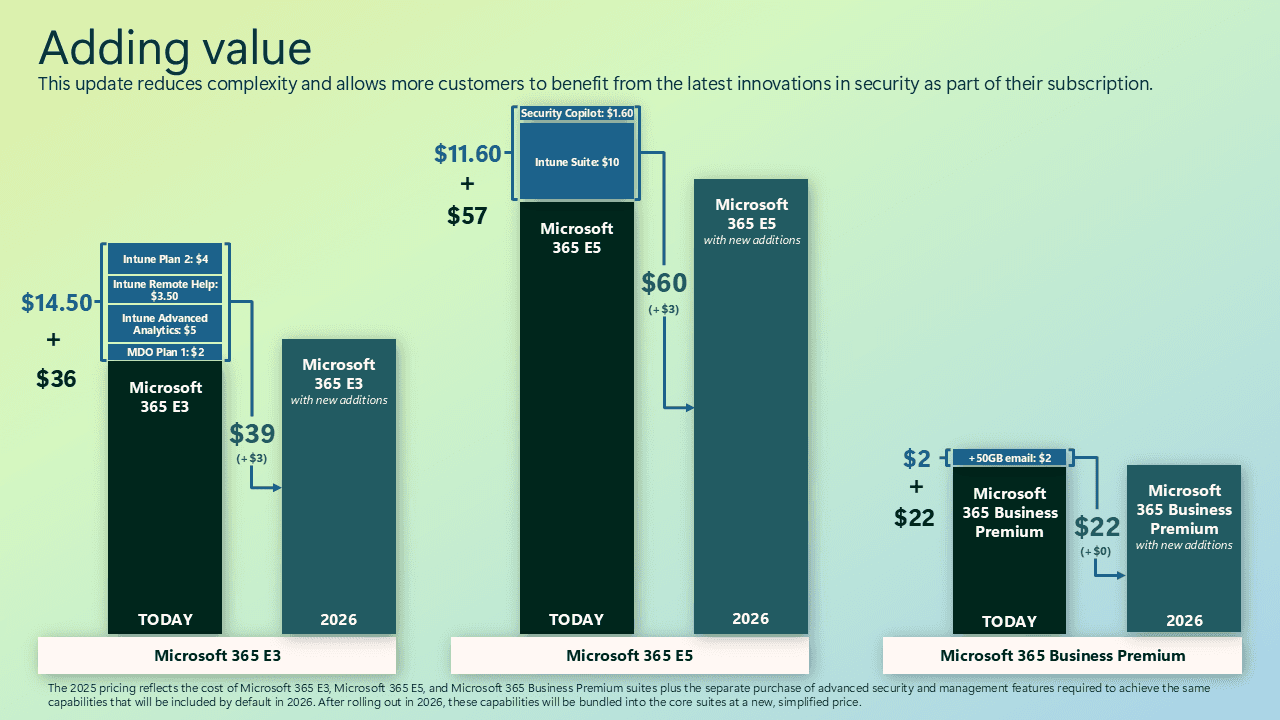
On July 1, Microsoft is restructuring how Microsoft 365 suites are packaged. Security and management capabilities that were previously licensed separately are being bundled into the base suites. This consolidation raises the baseline price per license, uniformly, regardless of whether you deploy the new capabilities.
What's being added (see capability matrix below): Copilot enhancements, URL inspection, +50GB email storage, Microsoft Defender, Intune capabilities, Microsoft Cloud PKI, Microsoft Security Copilot, depending on your suite tier.
What this means for costs: Organizations that were already licensing these capabilities separately will see bundled pricing that may offset the increase. Organizations that weren't will simply pay more per seat.
More importantly: the cost of carrying inactive licenses, dormant accounts, or over-assigned seats increases permanently. Once new pricing locks in at renewal, every unnecessary license becomes materially more expensive for the full contract term.
The organizations that benefit aren't the ones celebrating lower prices. They're the ones that know exactly who needs which license before July 1 arrives.
Capability matrix showing what's bundled into each suite tier:
The real planning window: February 1 to July 1
Prices don't change automatically for existing customers. New pricing only applies when SKUs renew or are newly purchased. Your renewal date is the planning deadline.
If you're renewing in January:
Renewing annual terms in January locks pricing before the February 1 currency adjustments take effect. For organizations in the affected currencies, this means committing to the pre-adjustment price for the entire contract term.
If your renewal is imminent and you have some flexibility, it may be possible to move temporarily to a monthly term before February 1, rather than committing directly to a new annual agreement. Monthly pricing typically carries a short-term premium, 20 percent, but it preserves optionality: you can bridge the period until the February currency adjustment takes effect, and then commit to an annual or multi-year term at the adjusted local price.
In some purchasing programs, such as Cloud Solution Provider, this option is explicitly supported. In many cases, the short-term premium is recovered within 6 to 9 months through the lower locked-in rate, assuming the licenses being renewed are actually needed.
This is a time-sensitive trade-off and only works if you know which licenses you truly need. If you do, making this choice now can materially improve your costs through mid-2027.
This is the point where it makes sense to involve your licensing partner to confirm renewal dates and available options, and to ask about a temporary move to monthly billing if your annual term is imminent.
Before you call your licensing partner, gather the following:
Renewal dates for all Microsoft SKUs you manage.
Current license counts by SKU and an estimate of dormant or inactive accounts.
A list of add-ons or separate licenses you currently pay for.
Your preferred contract lengths (12 months, 36 months) and any budget constraints.
The internal owners for procurement and identity/licensing data.
Key questions to ask your licensing partner:
Can we move this subscription to monthly temporarily, and what is the premium?
If we bridge to monthly, how do we re-enter an annual or multi-year term later?
Which SKUs in our estate renew in local currency and how will February 1 adjustments affect invoices?
How will the July suite changes affect our current add-ons, and can costs be converted or offset?
Can you provide a usage or identity report so we can confirm active users before renewing?
If your renewals fall between February and June 2026: You can capture the adjusted local-currency pricing and lock it in for 12 or 36 months before the July suite changes take effect. That currency adjustment, potentially 7 to 13% in affected markets, compounds across the term.
If your renewals are July or later: You will face the new baseline suite pricing after consolidation. There is no currency-window advantage to capture; you need identity visibility to decide whether the bundled capabilities are worth the new baseline.
Renewal timing and commitment length are financial levers, not administrative details. Organizations that use them strategically enter 2026 with options; those that default to standard cycles absorb avoidable costs.
Visibility is control
Timing creates opportunities. Visibility enables you to take them.
If you know which identities are active, which licenses are in use, and which accounts are dormant, you enter the Feb-July window with options. You can optimize before locking in pricing. You can make confident decisions about which licenses to renew and at what commitment level.
If you don't have that visibility, you're renewing blind. You're locking in costs for accounts you can't verify, licenses you can't track, and identities you can't explain.
In 2026, that costs more than ever. Every unnecessary license you renew becomes meaningfully more expensive for the full contract term, and there is no going back.
Start now. Understand your current identity landscape. Know which accounts are real, which are dormant, which licenses are assigned but unused. The Feb-July window is your planning period. What you learn in January determines what control you have in February.
The bigger takeaway
The February currency adjustments realign local prices. The July suite increase raises the baseline. Together, they create urgency.
But urgency without visibility is just stress.
Organizations that understand their identity landscape, user activity, and license usage enter this window with options. Those that don't are left reacting to renewal dates and list prices, absorbing unnecessary costs they could have prevented.
Pricing changes are inevitable. Control is optional.
Resources
Hear when the next article is out
Our newsletter tells you when a new article is out. About once a month.